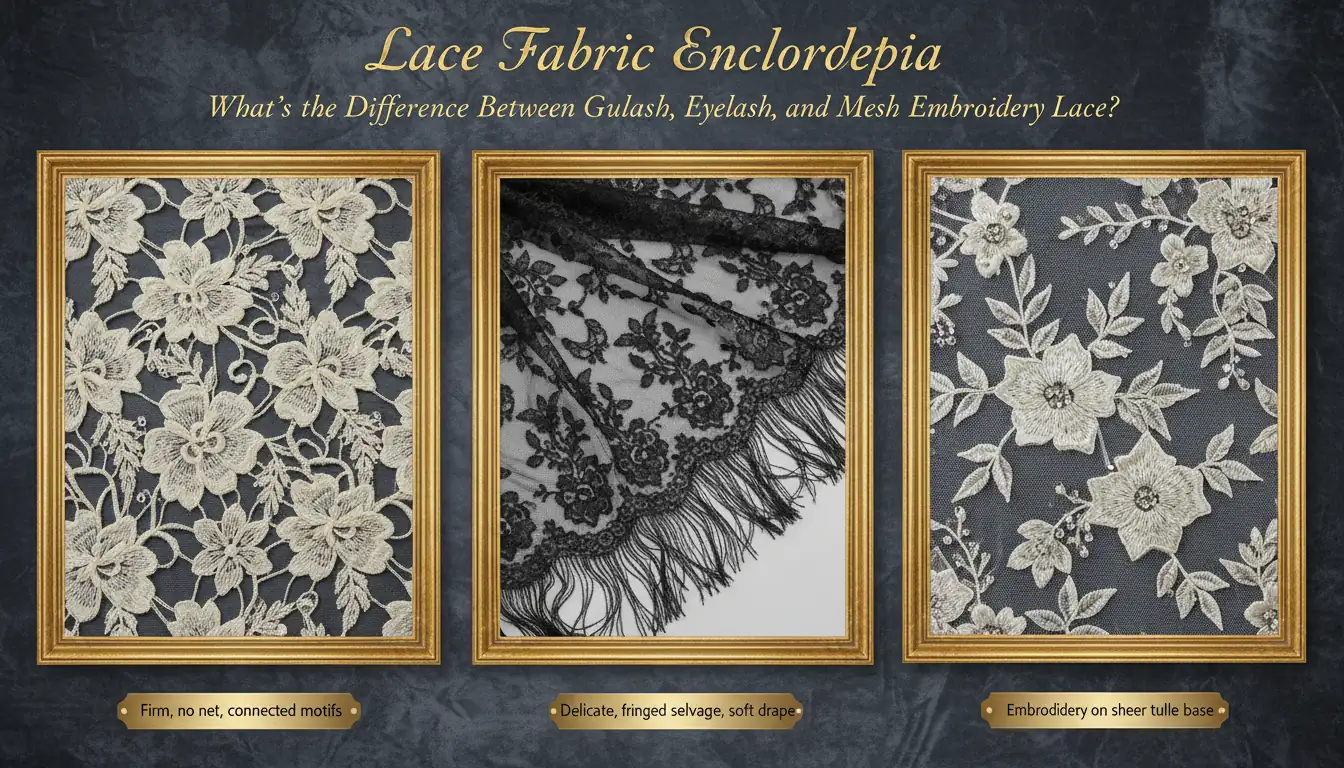
Lace Fabric Encyclopedia: What's the Difference Between Guipure, Eyelash, and Mesh Embroidery Lace?
Lace fabrics have become integral components in the textile industry, especially for high-end apparel and intricate designs. Understanding the distinctions between guipure lace, eyelash lace, and mesh embroidery lace is critical for procurement managers and fabric product developers. Each type of lace offers unique characteristics, production methods, and applications, influencing decisions on sourcing and manufacturing. In this guide, we delve into the technical aspects and supply chain considerations essential for sourcing these fabrics effectively.
Overview of Lace Types
Lace can be broadly categorized based on its structure and production techniques. The primary types discussed here include:
- Guipure Lace: A heavy, embroidered lace characterized by its raised motifs.
- Eyelash Lace: A delicate lace featuring short, fringed edges that resemble eyelashes.
- Mesh Embroidery Lace: A lightweight lace made from a mesh base with intricate embroidery.
Production Techniques
Guipure Lace Production
Guipure lace is typically made using a combination of cotton and synthetic fibers. The production process involves:
- Using specialized embroidery machines to create intricate patterns.
- Employing high-density stitching techniques to enhance durability.
- Implementing stringent quality control measures to meet OEKO-TEX Standard 100.
Eyelash Lace Production
This lace is produced using a unique technique that creates a soft, textured finish. The process includes:
- Utilizing lightweight yarns for a delicate appearance.
- Employing advanced lace-making machinery that allows for intricate designs.
- Conducting rigorous testing for tensile strength and elasticity.
Mesh Embroidery Lace Production
Mesh embroidery lace combines a mesh base with embroidered elements through the following steps:
- Creating a base from fine mesh fabric, often polyester or nylon.
- Applying embroidery techniques to add decorative motifs.
- Ensuring compliance with industry standards such as AATCC testing for colorfastness.
Technical Specifications Comparison
| Type | GSM | Composition | Width |
|---|---|---|---|
| Guipure Lace | 150-300 | Cotton/Synthetic | 130-150 cm |
| Eyelash Lace | 50-100 | Polyester/Nylon | 120-140 cm |
| Mesh Embroidery Lace | 80-200 | Polyester/Nylon | 130-160 cm |
Quality Control Standards
Quality control is a fundamental aspect of lace fabric production. Each type adheres to specific standards:
- OEKO-TEX Standard 100: Ensures that textiles are free from harmful substances.
- AATCC Standards: Focus on colorfastness, shrinkage, and fabric strength.
- ISO Compliance: Upholds manufacturing processes that meet international quality benchmarks.
FAQ
What is the typical sample lead time for lace fabrics?
Sample lead time varies but typically ranges from 7 to 14 days, depending on the custom lace manufacturer.
What is the minimum order quantity (MOQ) for lace fabric?
The MOQ for lace fabrics generally starts at 100 meters, but this can vary based on the supplier and type of lace.
Can I customize the designs of lace fabric?
Yes, many custom lace manufacturers offer design customization to meet specific client requirements.
What is the difference between lace fabric and embroidered lace fabric?
Lace fabric is a broader category that includes various types, while embroidered lace fabric specifically refers to lace with decorative embroidery applied.
Where can I source lace trim?
Contact a reputable lace trim supplier who specializes in high-quality lace products for your sourcing needs.
For further information on lace types, you may explore our other articles: What Is Lace Fabric, What Is Guipure Lace Fabric, or Lace Fabric vs Mesh Fabric.
In conclusion, understanding the differences between guipure, eyelash, and mesh embroidery lace is crucial for effective procurement and manufacturing. Request a Free Sample Swatch from Shaoxing Yituo to evaluate the quality and suitability for your specific applications.